
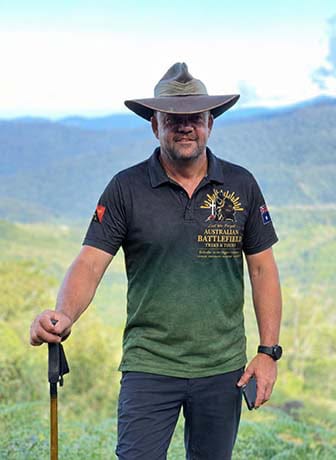
Scott Babington
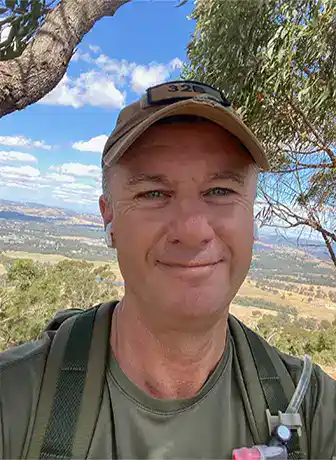
Tim Whitford

Graeme Walker
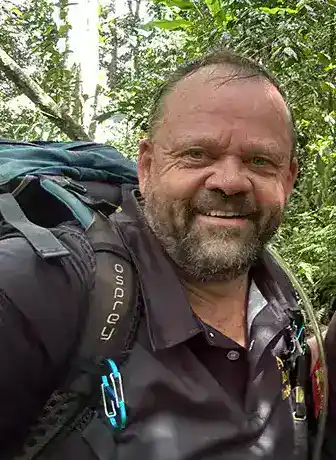
Scott Babington, founder and director of Australian Battlefield Treks and Tours, brings together a long career of military service, leadership, instruction, and historical research. His background in the Australian Army, operational deployments, and lifelong study of military history gives trekkers a guide who understands both the realities of service and the significance of the Kokoda campaign. Through Australian Battlefield Treks and Tours, Scott combines professional military experience with a deep knowledge of the Kokoda campaign to give trekkers far more than a physical journey. His aim is to bring the story of the soldiers who fought in Papua New Guinea to life with clarity, respect, and historical depth.
Founder & Director
Australian Battlefield Treks and Tours
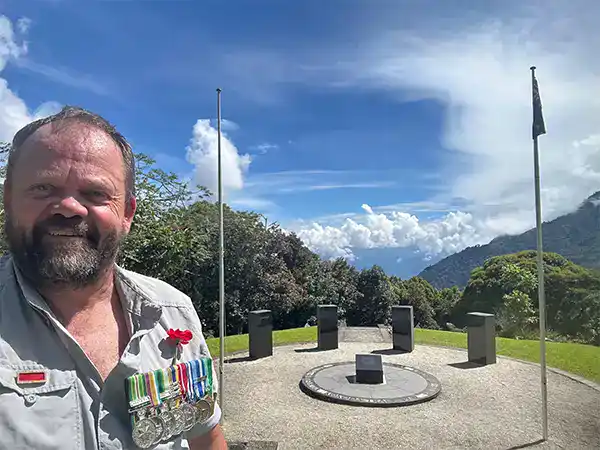
For Scott Babington, military history has never simply been about battles, dates or places. It has always been about people.
It is about understanding the courage, endurance, mateship and sacrifice of the Australians who served our nation, and ensuring that their stories continue to educate and inspire future generations.
Scott believes that every battlefield has a story to tell, every memorial represents a life of service, and every journey across these historic landscapes provides an opportunity to better understand the character, mateship and determination that have shaped Australia’s military heritage.
Few people are better placed to tell those stories.
Scott combines more than forty years of experience within the Australian Defence environment with a lifetime devoted to studying Australia’s military campaigns.
Having served as a soldier, tradesman, instructor, commissioned officer, United Nations Military Observer, operational adviser in Afghanistan and Defence educator, he brings to every battlefield an insight that can only come from having lived the profession of arms.
Today, through Australian Battlefield Treks and Tours, Scott shares that experience by leading immersive battlefield tours across Kokoda, Gallipoli, the Western Front and Sandakan, helping travellers understand not only what happened, but why it happened and what it meant for the Australians who served there.
Born on the 17th of July 1968 in Armidale, New South Wales, Scott knew from an early age that he wanted a career in the military.
After completing Year 10 in 1984, he enlisted in the Australian Army as a sixteen-year-old Apprentice Fitter and Turner. His original ambition had been to join the Royal Australian Air Force because of his fascination with aircraft. However, a childhood go-kart accident at the age of twelve resulted in the loss of the tip of his left index finger, preventing him from pursuing that dream.
Instead, he embarked on an Army career that would span almost four decades and ultimately provide experiences that few Australians have the opportunity to enjoy.
Scott quickly demonstrated exceptional technical ability. In 1987 he represented the Australian Army at the national Work Skills Australia Competition, winning the Gold Medal in the Turning and Machining division. It was an early indication of the precision, discipline and pursuit of excellence that would define his career.
Over the next three decades Scott served with Engineer, Infantry and Armoured units, maintaining some of the Army’s most sophisticated equipment while developing a broad understanding of military operations and capability.
His career also included service as an instructor, where he mentored hundreds of young soldiers and airmen, passing on both technical knowledge and the values of military service. Developing people became one of the most rewarding aspects of his career and remains a passion today.
Scott’s higher leadership potential was recognised in 2004 when he was selected to receive a Queen’s Commission. Promoted to Captain in January 2005, he was immediately entrusted with leading one of the Army’s most significant workforce reform projects.
His task was to review the qualifications, skill sets and work value of the Royal Australian Electrical and Mechanical Engineers, analysing nine technical trades comprising more than 3,500 soldiers.
As the principal Defence representative before the Defence Force Remuneration Tribunal, Scott presented the Army’s case during formal hearings in Canberra in 2006, personally answering detailed technical questions from the Tribunal. Every recommendation was accepted, resulting in improved career structures and remuneration for approximately 3,500 Army tradespeople.
Operational service formed another defining chapter of Scott’s career.
In 1991 he deployed to Malaysia with the 6th Battalion, Royal Australian Regiment as part of Rifle Company Butterworth before deploying in 2007 to South Sudan as a United Nations Military Observer with the United Nations Mission in Sudan.
Working alongside military observers from twenty-three contributing nations, Scott monitored compliance with the Comprehensive Peace Agreement while conducting long range patrols throughout the remote regions of South Sudan.
Drawing upon his engineering background, he also assumed responsibility for managing the Team Site’s patrol vehicle fleet and trained multinational personnel in vehicle recovery, GPS navigation and remote-area operations.
Away from his official duties, Scott quietly established a humanitarian initiative to assist orphaned children in Juba. Three times each week he personally funded meals for local children and remained until every child had been fed.
Before leaving Sudan he ensured the initiative would continue under his successor — a simple act of compassion that remains one of the achievements of which he is most proud.
It was during leave from this deployment that Scott first visited Gallipoli.
Already an enthusiastic student of Australian military history, standing on the Gallipoli Peninsula transformed that interest into a lifelong commitment to preserving Australia’s battlefield heritage.
One moment in particular left an indelible impression. Scott’s great-great-uncle served with the 8th Light Horse Regiment during the First World War and was involved in the charge at The Nek.
Standing at The Nek, looking across the remarkably small area where so many young Australians lost their lives in a diversionary attack, was a profoundly humbling experience. Seeing the ground firsthand reinforced that no book or documentary can truly convey the realities of battle in the way that standing where history unfolded can.
Returning to Australia, Scott was appointed Operations Officer and later Second-in-Command of the Army School of Electrical and Mechanical Engineering, one of the Australian Defence Force’s largest and most complex training establishments.
Responsible for coordinating the training of almost 600 students and managing more than 140 instructional staff drawn from Army, Air Force, Defence civilians and industry, he led operational planning, resource management and the delivery of technical training across a diverse organisation.
In 2012 Scott deployed to Afghanistan as an Australian adviser embedded within the Headquarters of the United States 82nd Airborne Division at Kandahar Airfield.
His role involved mentoring senior members of the Afghan National Police across four provinces in southern Afghanistan and required frequent travel throughout contested areas, working closely with coalition forces, Afghan officials and village leaders.
Towards the end of his deployment Scott led an innovative project fitting twelve SPARKS mine-roller systems to Afghan National Police vehicles operating near the Afghanistan-Pakistan border.
Coordinating equipment, logistics, technical expertise and training, he established a sustainable capability that had the potential to significantly reduce casualties from improvised explosive devices — one of the most rewarding accomplishments of his operational service.
Following several further Army postings, Scott transferred to the Army Reserve in 2019, serving with C Company, 41st Battalion on the Mid North Coast of New South Wales before moving to the inactive Reserve. In total he completed thirty-eight years of military service.
Today Scott continues to contribute to Australia’s national defence as a Defence contractor, delivering training on emerging Defence capabilities and mentoring Australian soldiers, sailors and airmen as they learn to operate new technologies and military capabilities.
His role continues the work he has enjoyed throughout his career — developing people, building capability and preparing Defence personnel for future operational challenges.
Alongside his Defence career, Scott has devoted countless hours to researching Australia’s military history. Rather than simply reading about the campaigns, he has walked the battlefields, studied original accounts and sought to understand the decisions, hardships and leadership challenges faced by those who served.
Scott first trekked the Kokoda Track in 2018 and immediately developed a profound respect for both the campaign and the people of Papua New Guinea.
Two moments remain etched in his memory above all others: walking onto Brigade Hill for the first time and later entering the Isurava Memorial.
Standing where Australian soldiers fought against overwhelming odds, surrounded by the mountains that shaped the campaign, was an emotional experience that he describes as something he will never forget.
Those moments reinforced his commitment to ensuring that the story of Kokoda is remembered with accuracy, dignity and respect.
Scott’s passion for battlefield history extends well beyond Papua New Guinea. He has spent countless hours researching and walking the battlefields of Gallipoli and the Western Front while also studying in depth the tragic story of Sandakan and the Sandakan Death Marches.
He believes these battlefields are not simply places where battles were fought, but outdoor classrooms where leadership, sacrifice, resilience and mateship can still be understood by standing where history unfolded.
Unlike many battlefield historians, Scott has experienced military leadership firsthand. He understands the realities of planning operations, making decisions under pressure, leading people in difficult environments and operating in demanding conditions.
These lived experiences enable him to explain not only what happened on the battlefield, but why commanders made the decisions they did and how those decisions affected the Australians under their command.
As Founder and Director of Australian Battlefield Treks and Tours, Scott combines over forty years of Defence experience with a lifetime of military study to deliver immersive battlefield experiences across Australia’s most significant campaign locations.
Whether leading trekkers along the Kokoda Track, guiding visitors across the ridges of Gallipoli, walking the battlefields of the Western Front or sharing the moving story of Sandakan, his aim is always the same — to provide an experience that is historically accurate, professionally delivered and deeply meaningful.
Scott believes battlefield touring is about far more than visiting historic locations. It is about understanding the people who served, the decisions they faced, the hardships they endured and the legacy they left for future generations.
Tim Whitford is a native of Gippsland Victoria and has a long family history of service. He served as a Sergeant Main Battle Tank commander and has studied and written on subject of the Great War for his entire life.
He is world renowned for his role as part of the team that discovered and advocated for the recovery of the mass graves containing the “Missing Diggers of Fromelles”.
He’s one of only two Australians to be presented the “Medaille de commune de Fromelles” and deemed “Fromellois” (a villager of Fromelles) by the people of the village. His particular passions are the material culture of the common soldier and the topography of war. The study of the Great War has seen him employed as an educator at the Shrine of Remembrance in Melbourne and RSL Victoria before he retired in 2022. He has personally led hundreds of Australians on life changing pilgrimages to the old Western Front in the footsteps of the Diggers.
Graeme 'Wol' Walker has been lifelong student of the Great War. As a Royal Australian Armoured Corps soldier, he has spent more than four decades serving in the Australian Army, including serving alongside Scott and Tim. He has had a lifelong passion for Australian military history and has visited the AIF battlefields in France and Belgium with Tim on numerous occasions.
His focus on the human experience of war in the early twentieth century conflict at an individual level has been the focus of his study and research for more than twenty years.
With his long history of military service and his passion for sharing the stories of our service men and woman, Wol aims to give trekkers a greater depth of understanding of the conditions and experiences of those who endured the Western Front during the Great War.